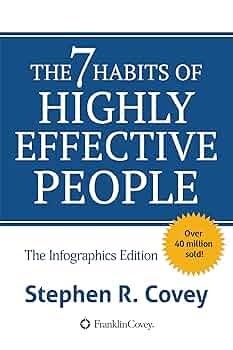
The 7 Habits of Effective People, Explained Simply
1. Be Proactive
Message: I am responsible for my response.
Instead of constantly blaming circumstances, people or situations, proactive people focus on what they can control or influence.
Example:
Reactive:
"My team doesn't cooperate, so I cannot perform."
Proactive:
"What can I do differently to improve cooperation?"
Training lesson:
Don't ask only, "Why is this happening to me?" Ask, "What can I do about it?"
2. Begin With the End in Mind
Message: Know where you want to go before you start walking.
Covey encourages people to clarify their vision, values and purpose.
Imagine yourself at the end of your career or life and ask:
What do I want people to remember about me?
What kind of leader do I want to be?
What kind of relationships do I want?
What contribution do I want to make?
This habit is particularly powerful for goal setting and leadership development.
3. Put First Things First
Message: Prioritise what is important, not merely what is urgent.
This is one of the most practical concepts in the book.
Covey distinguishes between:
Urgent Not Urgent
Important Crisis, emergency Planning, relationships, learning
Not Important Interruptions Time-wasting activities
The real growth happens when we spend more time in the Important + Not Urgent quadrant.
For example:
Learning
Exercise
Relationship building
Strategic planning
Employee development
Prevention
Personal reflection
This is extremely relevant for today's professionals because being busy does not necessarily mean being effective.
4. Think Win-Win
Message: Success does not always have to mean someone else loses.
Covey encourages people to look for solutions where both sides benefit.
Instead of:
"How can I win?"
Ask:
"How can we both win?"
This is particularly useful for:
Negotiation
Conflict management
Teamwork
Customer relationships
Leadership
Workplace relationships
For your team-building and soft-skills sessions, this habit can become an excellent activity-based module.
5. Seek First to Understand, Then to Be Understood
Message: Listen before you speak.
This is probably one of the most important communication lessons in the book.
Many people listen with the intention of replying, not understanding. The book therefore places strong emphasis on empathetic listening.
Instead of immediately saying:
"I know exactly what you're going through."
Try:
"Tell me more about what happened."
This habit connects beautifully with emotional intelligence, therapeutic communication and counselling skills.
6. Synergize
Message: Different people can create a better solution together.
Synergy means that differences aren't necessarily problems.
A team becomes powerful when people bring:
Different experiences
Different ideas
Different personalities
Different skills
Different perspectives
Instead of trying to make everybody think alike, effective teams learn to use their differences constructively.
Simple formula:
1 + 1 > 2
The collective result can be greater than what individuals could achieve separately.
This makes Habit 6 particularly relevant to team building and overcoming groupism.
7. Sharpen the Saw
Message: Take care of yourself so that you can continue to perform effectively.
Covey's final habit is about renewal.
Think about four dimensions:
🧠 Mental – learning, reading, reflection
❤️ Emotional/Social – relationships and emotional well-being
🏃 Physical – exercise, nutrition, rest
🌿 Spiritual – values, purpose and inner reflection
The important idea is that continuous performance requires continuous renewal.
This habit fits especially well with your JALSA lifestyle and wellness philosophy because it connects effectiveness with sustainable well-being rather than simply working harder.
⭐ What I Like Most About the Book
1. It goes beyond motivation
Many self-help books tell you:
"Work harder."
Covey asks:
"Are you working on the right things for the right reasons?"
That's a much deeper question.
2. It connects personal and professional life
The habits aren't restricted to the office.
They can be applied to:
Marriage
Parenting
Leadership
Friendship
Teamwork
Business
Personal development
Conflict management
3. It teaches character, not just techniques
The book argues that lasting effectiveness depends on qualities such as integrity, fairness, honesty and human dignity.
4. It is highly useful for trainers
For a soft-skills trainer, the book is almost a ready-made framework for multiple training programmes.
You can develop sessions around:
Proactivity → Goal Setting → Time Management → Win-Win → Communication → Teamwork → Self-Care.
Limitations of the Book
A good review should also mention its limitations.
1. Some concepts feel repetitive
Covey explains his principles at considerable length. Modern readers who prefer short, fast-paced books may find some sections slow.
2. Some examples feel dated
Because the original book was published in 1989, some workplace and family examples don't completely reflect today's environment of:
Social media
Remote work
AI
Hybrid teams
Digital overload
3. Individual responsibility can be over emphasized
"Be proactive" is powerful, but not every problem is caused by an individual's attitude. Organizational culture, economic circumstances, leadership and systemic constraints also matter. Contemporary reviews have pointed out this limitation.
So I would recommend adapting Covey rather than following it mechanically.
My Overall Review :
The 7 Habits is not really a book about becoming "successful."
It is a book about becoming purposeful, responsible, trustworthy and effective.
Its greatest lesson is:
Don't try to change the world before you learn to manage yourself.
And once you can manage yourself:
Self-management → Effective relationships → Effective teamwork → Leadership → Sustainable growth
The book remains highly relevant because its core ideas are about human behaviour rather than technology or trends. Reader ratings also remain strong, with Goodreads showing roughly 4.16/5 from more than 840,000 ratings.
Final Rating
Area Rating
Personal Development ⭐⭐⭐⭐⭐
Leadership ⭐⭐⭐⭐⭐
Communication ⭐⭐⭐⭐⭐
Team Building ⭐⭐⭐⭐⭐
Time Management ⭐⭐⭐⭐½
Modern Workplace Relevance ⭐⭐⭐⭐
Practical Application ⭐⭐⭐⭐½
Overall 4.5/5
One-line takeaway
"Effectiveness is not about doing more things; it is about becoming the kind of person who consistently does the right things with the right people for the right reasons."
 August 31, 2026